
Rajnath is the first Indian Defense Minister who visited Australia since 2013. This has come to notice after Australian Counterpart Richard Marles casted light on this.

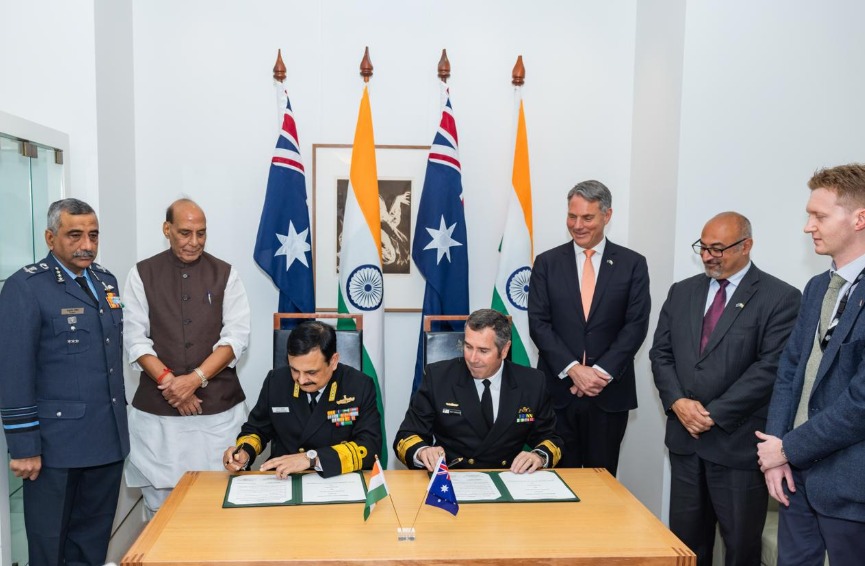
The Defense Ministers of Australia and India on Thursday signed a new bilateral security agreement. Australia claims this agreement to maintain Indo-Pacific stability.
Rajnath is the first Indian Defense Minister who visited Australia since 2013. This has come to notice after Australian Counterpart Richard Marles casted light on this.
In a statement, Marles’ office stated, “Australia and India are top-tier security partners, and our defense cooperation delivers practical effects to uphold Indo-Pacific stability.”
A forum for joint staff discussions and submarine rescue cooperation between the two militaries was established as part of the agreement struck by Marles and Singh.
Before the signing, Marles remarked, “The bilateral arrangements that will be signed today reflect the significant growth in our defense partnership and our shared ambition for its future.”
When India took part in the biennial Talisman Sabre multination military exercises in Australia for the first time in July, closer defense ties were made clear.
In 2005, the United States and Australia collaborated to launch Talisman Sabre. Over 35,000 military people from 19 countries participated this year.
At their July meeting in Washington, the foreign ministers of the four nations decided to deepen their collaboration on Indo-Pacific maritime security.
Singh’s visit to Australia was “highly significant” in both symbolic and practical senses, according to Raji Rajagopalan, a senior fellow at the Australian Strategic Policy Institute think tank.
According to her, Marles had made multiple high-level contacts in India, but it had been 12 years since an Indian defense minister had come to Australia.
According to Rajagopalan, India participated in the strategic conflict between China and the US in the Indo-Pacific by using these bilateral ties.
How close India wants to become to the United States is still influenced by a lot of historical reluctance. However, India is also realistic enough to understand that if China is its biggest national security issue, it must cooperate with the United States to resolve it, Rajagopalan stated.
Multilateralism and the Quad, in my opinion, also provide India with a kind of middle ground if it is concerned about U.S.-India relations and becoming close to the United States as a security partner. As a result, India is collaborating not only with the United States but also with Japan, Australia, France, and other nations. In terms of strategic spacing and relationship management, it does provide India a little more flexibility,” she continued.
Australia and its island neighbors in the South Pacific have been establishing bilateral security relations. In order to integrate their defenses, Australia and Papua New Guinea signed a defense treaty on Monday. It is the only alliance-level security agreement that Australia has, aside from the 1951 ANZUS Treaty with the United States and New Zealand.