
The judgement has been passed on Thursday after two FIRs were registered in February 2015 by the Special Investigation Team (SIT).

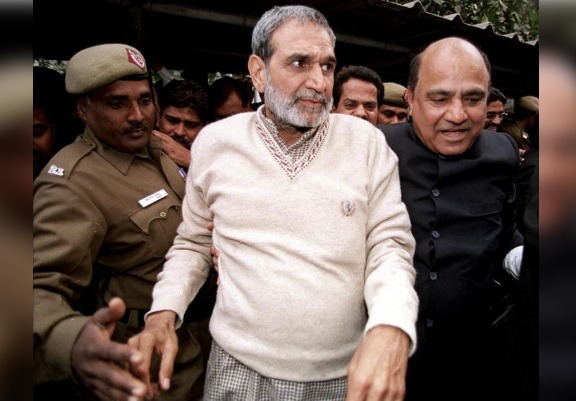
Delhi Court on Thursday gave a verdict that Former Congress MP Sajjan Kumar is not guilty in a case related to alleged mob violence in West Delhi’s Janakpuri and Vikaspuri areas. It is a major development linked to the 1984 Anti-Sikh Riots as mob violence was reported following the assassination of then Prime Minister Indira Gandhi.
While at the hearing, Special Judge Dig Vinay Singh of the Rouse Avenue Court acquitted Sajjan Kumar of all the charges of rioting and promoting opposition in connection with the deaths of Sohan Singh and his son in laws Avtar Singh and Gurcharan Singh.
The court notably delivered an order orally, however the detailed judgement is awaited.
Despite such judgement, Sajjan Kumar will continue to remain in jail as he is already serving a life sentence in a separate 1984 riots case.
What the Court Said?
The judgement has been passed after two FIRs were registered in February 2015 by the Special Investigation Team (SIT). It was registered under orders of a court-appointed panel investigating long-pending riot cases.
One FIR related to the deaths in Janakpuri and the other to the violence in Vikaspuri.
During the court proceedings, the Judge gave a verdict after observing the statements of witnesses and the evidence presented by the prosecution. The Judge stated that the evidence is not strong enough to prove Sajjan Kumar guilty.
The prosecution examined a total of 18 witnesses in the case, including nine people who claimed to be eyewitnesses to the incidents. However, the court pointed out that there were major contradictions and gaps in their accounts, which weakened key aspects of the prosecution’s case and made it difficult to uphold the charges against Kumar.
Cases Against Sajjan Kumar
Former MP Sajjan Kumar has his connections with a long list of cases linked to the 1984 Anti-Sikh Riots. He has remained a key accused of legal proceedings over several decades.
The list is as follows-
- Year 2018 High Court Conviction and Life Sentence: Whilst the riot cases were reopened by the Special Investigation Team (SIT), the Delhi High Court announced Sajjan Kumar was involved in the killing of five Sikh men.
Not only this, he as well was found guilty of being involved in the burning of a gurdwara in Palam Colony in southwest Delhi during the 1984 riots. The court sentenced him to life imprisonment for the rest of his natural life. - Year 2025 Life Sentence in separate Murder Case: In February 2025, Sanjjan Kumar was convicted for the murder of Jaswant Singh and his son, Tarundeep Singh. The case was of the times of riots in the Saraswati Bihar area of Delhi.
Sajjan Kumar, now in his late seventies, is serving life sentence for several of the cases. He is currently in Tihar Jail.
The Long Quest for Justice: 1984 Anti-Sikh Riots
The 1984 anti-Sikh riots broke out after then Prime Minister Indira Gandhi was assassinated by her Sikh bodyguards on October 31, 1984. The assassination triggered large-scale violence against Sikh civilians, particularly in Delhi.
According to official figures, nearly 2,800 people were killed in Delhi alone, while thousands of others were injured and widespread damage was caused to homes, businesses and religious sites.
In the aftermath of the violence, thousands of First Information Reports (FIRs) were registered in Delhi and other parts of northern India. However, over the years, many of these cases were poorly investigated, closed as “untraced,” or ended in acquittals. This led to allegations of serious failures by the police and investigating agencies, and caused deep frustration among survivors and victims’ families over the slow and uneven delivery of justice.
After the Special Investigation Team was set up in 2015 to reinvestigate the cases, only a limited number, a few dozen out of hundreds have resulted in convictions so far.
Legal Community Voices
After Sajjan Kumar has been acquitted by the court, there has been reported contrasting reactions. A group of people has claimed that such is a setback to the struggle for accountability.
There have been reported arguments regarding the decades of delay and loss of evidence that continue to hinder justice.
Sajjan Kumar, a former Congress leader and a Member of Parliament for several terms in the 1990s and early 2000s, has long been a controversial figure in Indian politics. Specifically, for his role in 1984 Anti-Sikh riots.
A group of critics claimed that the people with authority were protected in the aftermath of violence, while courts and investigative bodies in recent years have tried to correct those earlier failures.
The recent verdict, which has come more than 41 years after the events of 1984, is expected to spark a fresh public debate over how justice is delivered in cases of communal violence and the difficulties involved in holding people accountable for crimes committed decades ago.