
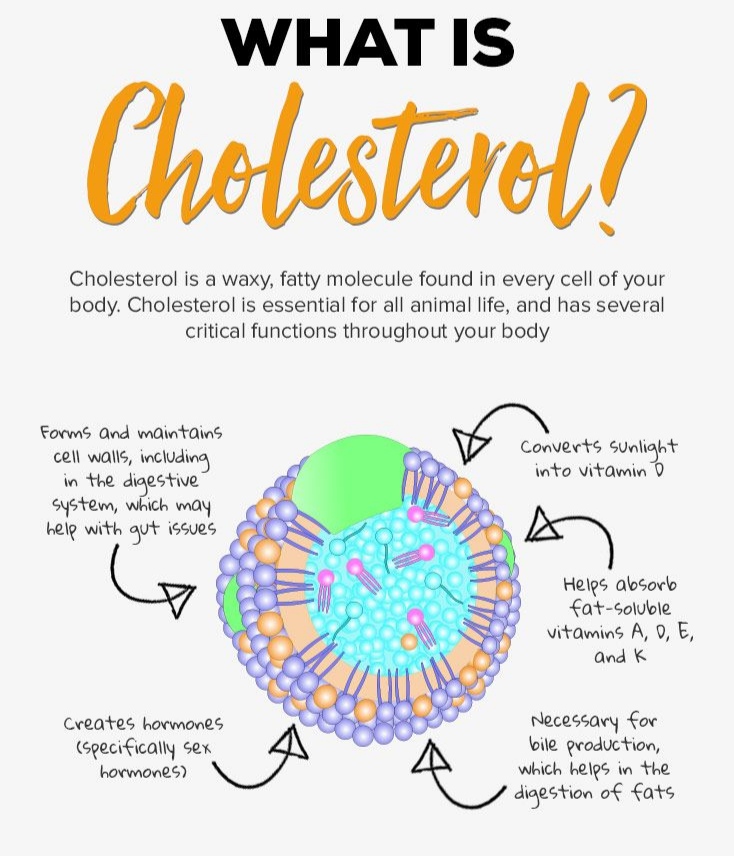
Cholesterol is the fatty substance produced by the liver, found in every body which has a wax like structure.

Cholesterol can be referred to as the component of the membrane of a cell which is a fat like substance. Cholesterol is the fatty substance produced by the liver, found in every body which has a wax like structure. It is a lipid, these are the organic compounds that are fatty and perform various functions. These are fats and oils whose formation is of glycerol. Fats and oils can be known as Triglycerides.
Functions of Triglycerides
- Energy storage
- Provide insulation
- Helps absorb vitamins that are fat soluble.
- Fats are solid (room temperature)
- Oils are liquid
Types of Cholesterol
There are two types of cholesterol and both of them vary in their density; one is Low density Cholesterol and another one is High density Cholesterol.
Low density Cholesterol (LDL)
This type of Cholesterol is considered as bad Cholesterol. The reason for it is clogging of plaque in the arteries as a wax like whitish yellow deposit.
The plaque narrows the way for the blood to flow in the body, the arteries get stiff. Due to excessive plaque, the cholesterol can break out in the arteries carrying blood including the waste and the other unhealthy fats of the body.
The LDL is the main reason for the fatty liver problems . When the level of cholesterol rises above 130mg/dl, often results in bad cholesterol which can put an individual on high risk of strokes causing blood clots in brain and arteries
High Density Cholesterol (HDL)
This type of Cholesterol can be considered as good cholesterol. The main function associated with it is removing the lipid from the arteries. The removed lipid from arteries go back to the liver which reduces the risk of fatty liver and blood clots.
The HDL is considered normal if it ranges till 40, any level lower than 40mg/dl is considered low level of cholesterol.

Tips to manage fatty liver and Bad cholesterol
Tip 1: Avoid meat, beef, high fat or whole dairy.
Tip 2: Go vegan
Tip 3: Fast for one day in a week
Tip 4: Avoid refined sugars
Tip 5: Do not consume high caffeinated drinks
Tip 6: Alcohol is the most common reason for it, Say no to Alcohol.
Tip 7: Exercise for at least one hour a day
Tip 8: If on medication, never skip the appointments and get lipid profile check daily.
Tip 9: Consume nuts every day as Cholesterol affects the Vitamin D and ruins the lipoproteins. For women, it is an important part as cholesterol plays a big role in producing hormones like estrogen that are responsible for menstrual cycles.
Tip 10: Say a big no to Palm oil, white sugar and white bread.
According to a research by Harvard University, “Only about 20% of Cholesterol is produced by food we eat and the rest, the body makes it.” So, it is important to give that 20% clean to the body.