
Jaswant Singh Khalra was a renowned Sikh human right activist who with no fear uncovered the evidence of abduction, illegal cremation, and murder of thousands of innocent Sikhs by the Punjab Police during 1980s and 1990s.

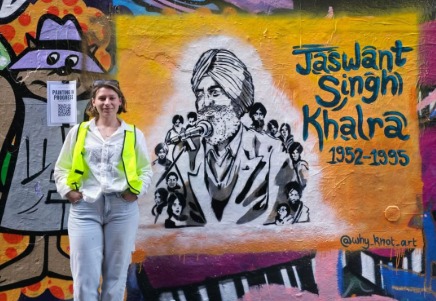
Shaheed Jaswant Singh Khalra’s mural has been painted in Melbourne’s famous Hosier Lane. This amazing artwork has been done @why_knot_art in honor of Shaheed Jaswant Singh Khalra on his 30th Shaheedi Anniversary.
why_knot_art is run by Bethany Cherry who is a Brilliant Muralist. She specialises in creative content and communication. She has done her graduation from the University of Melbourne with a Bachelor of Design. She has also worked as an editor of the University’s magazine ‘Farrago.’
The brilliant Mural portrays the painting of activist Jaswant Singh Khalra, besides, it is written “Jaswant Singh Khalra” and “1952-1995.” The bold colors have been used, making it eye-catching.
Who is “Shaheed Jaswant Singh Khalra?”
Jaswant Singh Khalra was a renowned Sikh human right activist who with no fear uncovered the evidence of abduction, illegal cremation, and murder of thousands of innocent Sikhs by the Punjab Police during 1980s and 1990s.
He was born in Village Khalra which is located in District Tarn Taran, Punjab. He had roots from the family who was always involved in activism. His grandfather, Harnam Singh, was actively involved in the Ghadar movement and the Komagata Maru incident of 1914.
An activist, Khalra was a graduate and had worked as Panchayat Secretary, after that he worked as the Director of Cooperative Bank in Amritsar.
In January 1995, he issued a press release in which he exposed over 2000 mass cremations in Amritsar. Over the time, he estimated that 25000 killings and cremations were carried out by the police, including murders of officers who resisted participation.
On September 6, 1995, while Khalra was washing his car outside his home in Amritsar, was kidnapped and killed by Police Officers. Confirmation to it came in 1996 when CBI (The Central Bureau of Investigation) mentioned his detention and recommended charges against multiple officers.
After 10 years of his death, in 2005, six police officials were found guilty. From these, two were announced with life sentence, while others initially received seven years terms. But then, in 2007, the Punjab and Haryana High Court upgraded four of those sentences into life imprisonment.
Jaswant Singh Khalra’s Personal Life
Activist Khalra was married to Paramjit Kaur Khalra and they had two children. After Khalra died, his wife continued his struggle for justice through Khalra Mission Organisation and his family actively is involved in preserving his memory.

Khalra’s Siblings and descendants reside across the UK, Austria and India. Notably, his work has been documented in a biography; “Darkness Defied by Ajmer Singh.” This book was released in English in June 2025.
Global Recognition and Media
Internationally, Khalra’s contributions have been celebrated in multiple ways:
- In Fresno, California, a park was renamed in his honor in 2017
- In early 2025, the Central Unified School District inaugurated Jaswant Singh Khalra Elementary School, marking the first U.S. public school named after someone of Sikh heritage; his wife and daughter attended the opening.
- A high-profile biopic titled Panjab ’95, starring Diljit Dosanjh, was made based on Khalra’s life. Though slated for an international release in 2025, the film remains unreleased in India due to censorship demands for as many as 120 cuts.
- On Khalra’s 30th death anniversary on September 6, a March for Human Rights and Remembrance was organised from Federation Square Melbourne to State Library Victoria.
.