
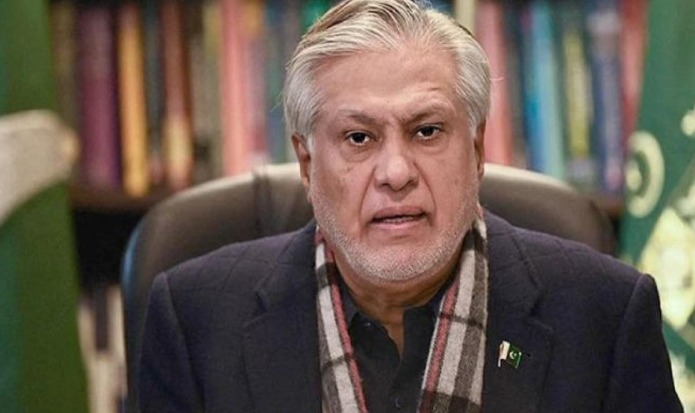
Dar reiterated Pakistan’s position regarding claim that India had attacked Nur Khan first, resulted in Pakistan retaliating with attacks.

Eight months following the short yet fierce military clash between India and Pakistan in May, Islamabad has openly recognized the effects of Indian attacks on a significant Pakistani military installation for the first time comprehensively.
Ishaq Dar, Pakistan’s Deputy Prime Minister and Foreign Minister, confirmed that during India’s Operation Sindoor, Indian drones attacked the Nur Khan airbase in Rawalpindi’s Chaklala area, resulting in infrastructure damage and injuries to the stationed personnel.
During a year-end press conference last week, Dar outlined the magnitude of the Indian operation, noting that multiple drones were deployed in quick succession. He stated that Pakistan’s air defence systems thwarted the majority of them, though he admitted that the airbase suffered damage.
In the early morning hours of May 7th, 2025, India began “Operation Sindoor.” It was initiated shortly after a terror attack that killed 26 civilians in Pahalgam, Jammu & Kashmir. The operation initiated an escalation of military activity between these two nuclear powers.
Nur Khan Airbase Strike: What Pakistan has officially Reported
Dar reported that Indian drones hit the Nur Khan airbase in the early hours of May 10. The facility is one of Pakistan’s most delicate military installations, situated 25 km from Islamabad and containing essential Pakistan Air Force (PAF) resources.
Though Islamabad previously minimized the effects of Indian attacks, Dar’s comments represent a notable shift from that stance, as he recognized both injuries and destruction at the site.
Pakistan asserts It will respond following Airbase Attack
Dar also reiterated Pakistan’s position regarding the claim that India had attacked Nur Khan first, which resulted in Pakistan retaliating with offensive attacks. Dar maintained that, at no point, did Pakistan wish to escalate a conflict but rather defended itself by retaliating.
Dar reiterated the Pakistani claim that, during the aerial conflict on May 07, several Indian fighters were shot down, but no evidence of this was provided.
In response to questions concerning the topic of diplomatic mediation efforts, Dar denied that, at any time, Pakistan made any attempt to initiate mediation with India during the conflict.
He stated that, after the conflict began, US Secretary of State Marco Rubio and Saudi Foreign Minister Prince Faisal bin Farhan both expressed an independent interest to communicate with New Delhi and find a solution to de-escalate the situation.
Dar stated that Rubio called him on May 10, in the early hours, and said that India was willing to agree to a ceasefire. Later, Dar said, Saudi Arabia assisted in connecting both sides, and both agreed to instead halt any further fighting.
President Zardari’s Bunker comment indicates serious concern
Dar’s admission comes after a notable remark by Pakistan President Asif Ali Zardari, who disclosed that he was suggested to relocate to a bunker as Indian attacks commenced.
Speaking to a public assembly, Zardari mentioned that his military secretary advised him to find safety, cautioning that conflict had begun.
The President believed that he turned down the trip and that the leader should be placed in danger rather than go back to safety.
Over the past few weeks, satellite imagery has confirmed that sections of Nur Khan Airbase have been reconstituted, which presumably suggests re-building work on infrastructure that was damaged during Indian air attacks.
Defence experts do not know what weapons were used during Operation Sindoor. It is believed that some combination of precision-guided munitions, such as BrahMos cruise missiles and SCALP air-launched missiles, were used. BrahMos is carried on Indian Air Force Su-30 fighter aircraft, while SCALP missiles are carried on Rafale jets.
Dar emphasized Pakistan’s enduring stance that enduring peace in the area hinges on addressing the Jammu and Kashmir conflict, despite India persistently associating military measures with cross-border terrorism.