

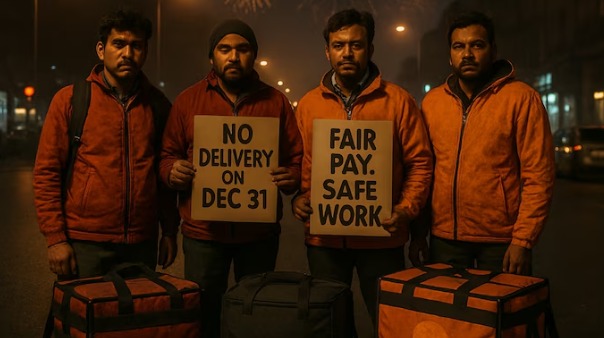
Workers linked to platforms including Zomato, Swiggy, Blinkit, Zepto, Amazon and Flipkart are expected to participate.

Food orders, grocery deliveries, and last-minute shopping on New Year’s Eve may face disruptions throughout India as gig and delivery workers organize a nationwide strike on December 31
Many applications and services which allow you to place food orders, purchase items quickly through the internet (and in person) and receive the items at home will be affected by heavy use of app platforms this New Year’s Eve, December 31, in many urban markets.
Unions are warning that many of these unions will be represented by employees at grocery stores, e-commerce businesses, etc., who depend on last mile delivery services to hit their Annual Sales Goals.
Workers linked to platforms including Zomato, Swiggy, Blinkit, Zepto, Amazon and Flipkart are expected to participate. Unions warn that the strike could hurt retailers and companies that rely heavily on last-mile delivery to meet year-end sales targets.
The strike was organized by both the Telangana Gig and Platform Workers Union (TGPWU) and the Indian Federation of Transport Workers Associations (IFAT), and backed by regional unions from Maharashtra, Karnataka, Delhi-NCR, West Bengal, and areas in Tamil Nadu. Unions claim that while workers are forced to work longer hours, their compensation is decreasing.
They claim that employees face hazardous delivery expectations, insecure job conditions, a lack of respect in the workplace, and limited access to social safeguards.
In a communication to Union Labour Minister Mansukh Mandaviya, IFAT stated that it represents almost 400,000 app-based transport and delivery workers across the country.
The federation observed that a countrywide flash strike on December 25 had already caused services to be disrupted by 50–60% in multiple cities. The protest aimed to draw attention to hazardous delivery practices, declining earnings, random account suspensions, and the lack of social protection.
IFAT also claimed that platform companies did not communicate with workers following the December 25 strike, but rather resorted to threats, account deactivations, algorithmic penalties, and employed third-party agencies to weaken the protest.
There is a potential that many customers may experience either a delay or cancellation while attempting to have orders delivered because delivery executives will likely stop using their apps after Dec. 31. In other case, they dramatically reduce their number of hours logged into these apps Beginning January 1, 2023, cities like Pune, Bengaluru, Delhi, Hyderabad and Kolkata along with various tier 2 markets will likely be negatively impacted.
In its correspondence, IFAT called on the government to regulate platform companies under labor laws, prohibit dangerous delivery methods like excessively fast delivery times, eliminate arbitrary ID suspensions, and implement clear wage systems..
It also requested social security benefits such as health insurance, accident coverage, and pensions, in addition to safeguarding workers’ rights to unionize and engage in collective bargaining.
The federation has demanded urgent action from the government and requested trilateral discussions that include the government, platform businesses, and labor unions.
The correspondence bears the signatures of IFAT co-founder and National General Secretary Shaikh Salauddin and Inayath Ali, who is the founder of the Karnataka App-Based Workers Union and National Vice-President of IFAT, with copies sent to high-ranking officials in the Labour Ministry.