
Following the talks, CM Mann reiterated that Punjab has no water to spare and highlighted the severe challenges posed by depleting water resources in the state.

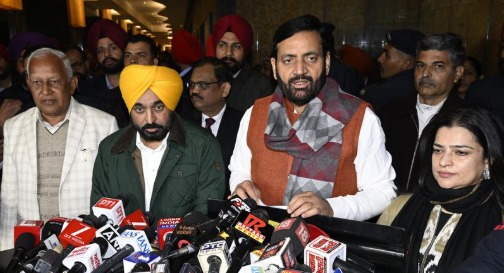
In a much-anticipated meeting held on Tuesday, Punjab Chief Minister Bhagwant Mann and his Haryana counterpart Nayab Singh Saini convened for nearly 40 minutes to re-energize efforts to resolve the long-standing Sutlej-Yamuna Link (SYL) canal dispute which is one of North India’s most contentious interstate water conflicts.
Though no breakthrough was achieved, both sides emerged from the session with a renewed commitment to dialogue and cooperation, agreeing to institutionalize discussions and form a joint committee of senior officials to work toward an amicable solution ahead of a crucial Supreme Court hearing scheduled for April.
What is at Stake?
The SYL canal project was envisioned in the 1980s to share water from the Ravi and Beas rivers between riparian Punjab and newly formed Haryana (after the 1966 state reorganization). Of the envisioned 214-km link, Haryana completed its 92-km portion while significant stretches in Punjab remain unbuilt amid political resistance.
At the heart of the dispute is Punjab’s long-held position that it does not have surplus water to share and that completion of the canal without an agreed-upon water-sharing formula would be unjust and potentially destabilizing. Haryana, on the other hand, insists on implementing Supreme Court directives to complete the canal and receive its rightful share.
Morning Talks and Continued Dialogue
Tuesday’s engagement began with an informal breakfast between the two leaders, followed by formal deliberations attended by irrigation and water resources ministers; Barinder Kumar Goyal (Punjab) and Shruti Choudhry (Haryana) along with senior officers including Punjab Chief Secretary KAP Sinha and Haryana Chief Principal Secretary Rajesh Khullar.
After the meeting, both chief ministers addressed the media, emphasizing that while immediate consensus remains elusive, institutional channels of dialogue will be strengthened. Under the new framework:
- Secretary-level officers from both states will meet every 10–15 days to advance negotiations.
- Outcomes will be reported to each state’s Chief Secretary, and subsequently to the Chief Ministers.
- Only once consensus is clearer will political and policy decisions follow.
“This issue is old and complex, but when discussions take place in a good atmosphere, meaningful results can follow,” Mann said at the briefing. “Haryana is not our enemy, but our brother.”
Mann’s Firm Stance: Protection of Punjab’s Rights
Following the talks, CM Mann reiterated that Punjab has no water to spare and highlighted the severe challenges posed by depleting water resources in the state. He underscored that forcing construction of the canal without a clear water-sharing deal could fuel law and order problems in Punjab.
“We are not depriving anyone of their rights,” Mann clarified, “but Punjab has no surplus water. Even now, we keep 40 percent of river waters for our own use while sharing the remaining 60 percent with non-riparian states including Haryana, Delhi and Rajasthan.”
Officials pointed out the deep-rooted nature of the dispute: decades of intermittent negotiations, court battles, and political brinkmanship have failed to produce a lasting formula for river water distribution. The Supreme Court has repeatedly urged cooperation between the states and directed them to explore a negotiated solution.
Haryana CM Saini’s Stance
CM Saini described the meeting as conducted in a “cordial atmosphere”, invoking the teachings of Guru Nanak Dev to underscore the importance of empathy and mutual respect. He said that such dialogue, if sustained, could lead to a constructive outcome and help fulfil the Supreme Court’s expectations.
Saini echoed the view that officers from both sides would continue deliberations and update their political leadership as discussions progressed. However, he did not retreat from Haryana’s demand for the implementation of the canal project as per court orders.
Political Reactions and Criticisms
The renewed talks have sparked mixed reactions across the political spectrum in Punjab. Senior Congress MLA Sukhpal Singh Khaira warned CM Mann against any commitment on sharing Punjab’s river waters, arguing that conceding ground without a strong, data-driven stance would betray the state’s farmers amid severe water scarcity.
Similarly, opposition leaders have criticised Mann for what they describe as diluting Punjab’s riparian rights. Shiromani Akali Dal president Sukhbir Singh Badal and other voices accused the chief minister of misusing spiritual metaphors such as the legacy of Bhai Kanhaiya to frame the state’s approach, a comparison they argue is historically and contextually misplaced.
Others have urged for an all-party meeting in Punjab to craft a unified stance ahead of the Supreme Court hearing, stressing that water rights transcend party politics and directly affect agriculture and public welfare in the long term.
April Supreme Court Hearing
The SYL canal dispute is slated to be heard by the Supreme Court in April 2026. Both states hope that sustained official-level talks can narrow differences before the hearing, potentially paving the way for a negotiated settlement that respects legal mandates, state interests and equitable sharing principles.
For now, the emphasis remains on building trust and managing expectations through regular engagement, a strategy both chief ministers and their officials hope will break the decades-old stalemate and avert further escalation in one of India’s longest-running interstate water disputes.