

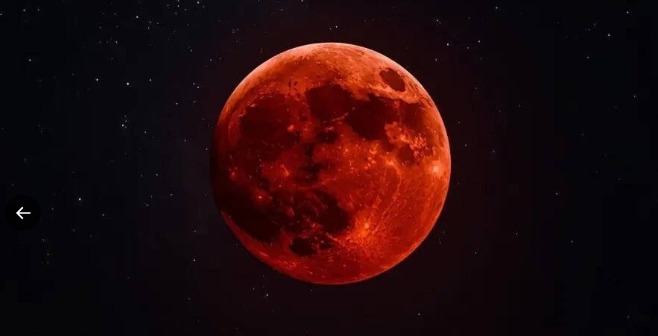
The leading night of September 7, 2025 to September 8, 2025, Lunar Eclipse will be visible across Asia, Australia, Africa and some parts of Europe.

India will witness a total Lunar Eclipse (Blood Moon or Chandra Grahan) on the leading night of September 7 to September 8, 2025. This year, it marks the longest eclipse in the last ten years.
What is Blood Moon?
As per NASA, “a Blood Moon happens during a total lunar eclipse. As sunlight passes through Earth’s atmosphere, the blue light is scattered while the red light is bent (refracted) toward the Moon, giving it a reddish color.”
Although, Blood Moon is not a scientific term, it refers to the reddish appearance of the Moon. The scientific term for this is “Total Lunar Eclipse.”
Science explains that when the Moon passes through Earth’s umbra (the central, darkest part of its shadow). And, Earth’s atmosphere refracts sunlight, scattering shorter wavelengths and allowing longer, redder light to reach the Moon. This makes the Moon appear red, Total Lunar Eclipse occurs.
“Tonight’s Blood Moon”
The leading night of September 7, 2025 to September 8, 2025, Lunar Eclipse will be visible across Asia, Australia, Africa and some parts of Europe. As per the estimations, it will last for 82 minutes in total, making it one of the longest in decade (period of 10 years).
According to the India Standard Time, the lunar eclipse will be of 3 hours and 28 minutes. The complete list is as follows:
- The eclipse will begin at 8:58 pm to 9:00 pm on September 7, 2025
- The totality will begin at 11:00 pm
- The maximum eclipse will be seen at 11:42 pm
- The totality will end at 12:22 am on September 8, 2025
- The eclipse will conclude by 1:25 to 1:27 am
The duration is 3 hours and 28 minutes including 82 minutes (11 pm to 12:22 am) of Lunar Eclipse.
Chandra Grahan: The Cultural Context of “Total Lunar Eclipse” or “Blood Moon”
In several parts of Asia, the Total Lunar Eclipse is locally known as “Chandra Grahan.” The Grahans come with traditional dos and don’ts which are linked to health and spiritual beliefs.However, today’s moon is safe for naked-eye viewing.
According to Hindu tradition, before and during Lunar and Solar Eclipse, Sutak Kaal is observed which spiritually is said to be inauspicious time. This is because, it is believed that during this period, the cosmic energies are disturbed, and the environment becomes spiritually and psychologically “contaminated.”
This year’s eclipse also coincides with Pitru Paksh, (a period dedicated to honouring ancestors). However, Shraadha rituals are only performed after Sutak ends.